
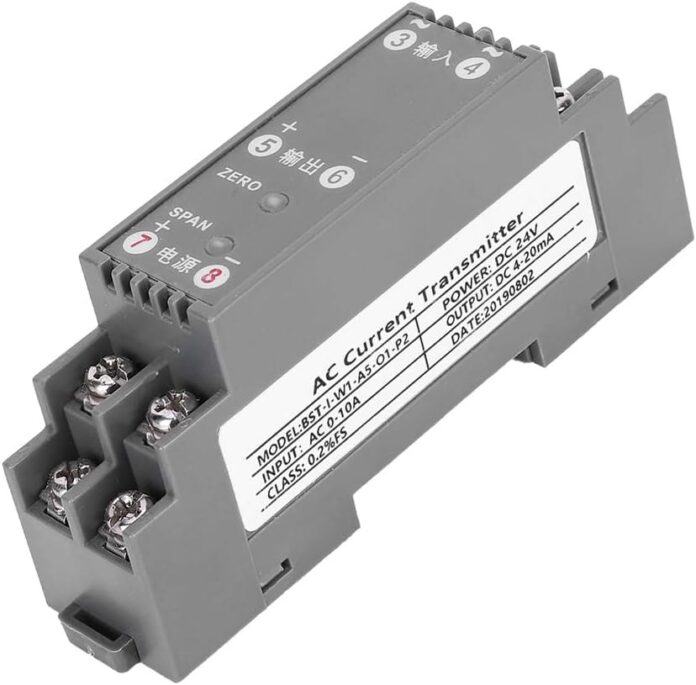
In various industrial applications, monitoring and controlling electrical currents are paramount for ensuring safe and efficient operation. Current transducers play a vital role in this process, especially in 4-20mA systems where they are widely used. This aimdynamics article aims to explore the significance, functionality, and applications of current transducers in the context of 4-20mA current loops.
Introduction to 4-20mA Current Loops
Before delving into current transducer 4-20ma, it’s essential to understand the basics of 4-20mA current loops. In industrial settings, where robustness and reliability are crucial, 4-20mA current loops are preferred for transmitting analog signals over long distances. Unlike voltage signals, current signals are less susceptible to interference and voltage drops over extended cable lengths.
In a 4-20mA current loop, the current varies linearly between 4mA and 20mA to represent the range of measured values. This standardized range allows for easy calibration and interpretation of signals by the receiving devices.
The Role of Current Transducers
A current transducer, also known as a current sensor, is a crucial component within a 4-20mA current loop. Its primary function is to convert the electrical current passing through a conductor into a proportional signal, typically a voltage or current, that can be easily measured or monitored by control systems or instrumentation.
Functionality of Current Transducers
Current transducers operate on the principle of electromagnetic induction or Hall effect. In electromagnetic induction-based transducers, the current flowing through a conductor generates a magnetic field, which induces a voltage or current in a secondary winding. This induced signal is then proportional to the primary current and can be further processed or transmitted.
On the other hand, Hall effect-based transducers utilize the Hall effect phenomenon, where a voltage is generated across a conductor when subjected to a magnetic field perpendicular to the current flow. By measuring this voltage, the magnitude of the primary current can be determined.
Applications of Current Transducers
Current transducers find extensive use in various industrial applications where monitoring and control of electrical currents are critical. Some common applications include:
- Motor Control: Current transducers are used to monitor the electrical current drawn by motors, allowing for efficient control and protection against overload conditions.
- Power Monitoring: In power distribution systems, current transducers measure the current flowing through conductors to monitor energy consumption and detect faults.
- Process Control: In industrial processes, current transducers play a vital role in monitoring and controlling the current levels of various equipment and machinery.
- Safety Systems: Current transducers are integrated into safety systems to monitor current levels and trigger alarms or shutdown mechanisms in case of abnormal conditions.
- Battery Management: In battery management systems, AC current transducers are utilized to monitor charging and discharging currents, ensuring optimal battery performance and longevity.
Advanced Features and Considerations in Current Transducers
Beyond their fundamental functionality, modern current transducers often incorporate advanced features to meet specific application requirements and enhance performance. Some of these features include:
- Isolation: Many current transducers offer galvanic isolation between the input and output circuits, ensuring safety and preventing ground loops. Isolated transducers are essential in applications where the measured current is subject to high voltages or where electrical isolation is necessary for safety reasons.
- Accuracy and Linearity: High accuracy and linearity are critical in applications where precise current measurements are required. Advanced current transducers employ precision components and calibration techniques to achieve tight tolerances and minimize measurement errors.
- Wide Operating Range: Some transducers are designed to operate over a wide range of currents, allowing for flexibility in various applications. These transducers can accurately measure currents ranging from a few milliamps to hundreds of amps, catering to diverse industrial needs.
- Temperature Compensation: Temperature fluctuations can affect the performance of current transducers. Transducers equipped with temperature compensation mechanisms ensure accurate measurements over a wide temperature range, maintaining stability and reliability in harsh operating environments.
- Digital Communication Interfaces: In modern industrial systems, digital communication interfaces such as Modbus, Profibus, or Ethernet are often preferred for seamless integration with control systems and data acquisition devices. Some current transducers feature built-in digital interfaces, enabling easy communication and data exchange with PLCs and SCADA systems.
- Overload Protection: Current transducers may incorporate overload protection mechanisms to safeguard against excessive currents that could damage the transducer or the connected equipment. These protection features include built-in current-limiting circuits or configurable alarms that trigger when the current exceeds predefined thresholds.
- Diagnostic Functions: Advanced current transducers may include diagnostic functions such as self-test capabilities or fault detection algorithms. These features help identify issues such as open circuits, short circuits, or sensor malfunctions, enabling proactive maintenance and troubleshooting.
Considerations for Selecting Current Transducers
When selecting a current transducer for a specific application, several factors should be considered to ensure optimal performance and compatibility:
- Measurement Range: Choose a transducer with a measurement range that encompasses the expected operating currents of the system, allowing for accurate monitoring across the entire range of operation.
- Accuracy and Resolution: Consider the required level of accuracy and resolution based on the application’s precision requirements. Higher accuracy transducers are necessary for applications where precise current measurements are critical.
- Environmental Conditions: Evaluate the environmental conditions such as temperature, humidity, and presence of contaminants to select a transducer with suitable environmental ratings and protection features.
- Electrical Compatibility: Ensure that the transducer’s input and output specifications match the electrical characteristics of the system, including voltage levels, frequency, and impedance.
- Mounting and Installation: Consider the physical dimensions and mounting options of the transducer to ensure compatibility with the installation location and ease of integration into the system.
By carefully evaluating these factors and selecting a current transducer that meets the specific requirements of the application, engineers and system integrators can ensure reliable and accurate current measurements, contributing to the overall efficiency and performance of industrial processes and systems.
Conclusion
Current transducers are indispensable components in 4-20mA current loops, facilitating the accurate measurement and monitoring of electrical currents in various industrial applications. Understanding their role, functionality, and applications is essential for ensuring the reliability and efficiency of control systems and instrumentation in industrial environments. As technology continues to evolve, current transducers will continue to play a crucial role in enabling precise and reliable current measurements for enhanced process control and safety.
You Might Also Like: What Exactly Is Single Pair Ethernet?
