
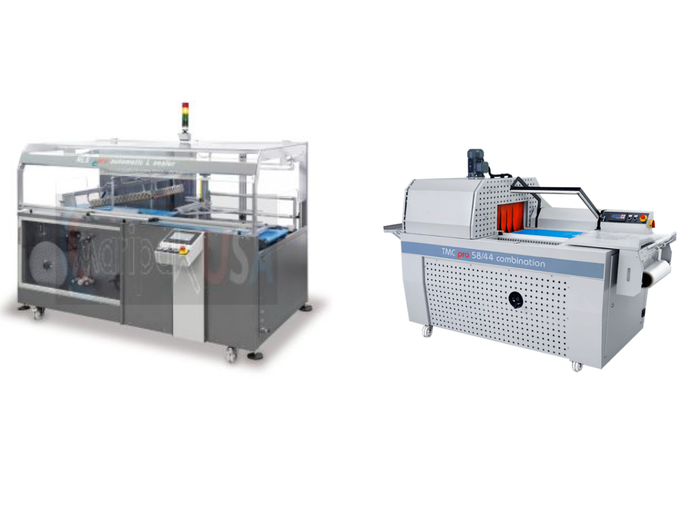
Shrink packaging can be used for a wide range of products, from boxed goods and printed materials to multipacks and retail-ready items. While the basic process seems straightforward, selecting the right equipment depends on far more than package size alone. Film type, production speed, product dimensions, automation level, heat requirements, and downstream handling can all influence performance.
A properly selected shrink packing machine should fit the actual workflow rather than forcing the workflow to adapt around the machine. For businesses comparing equipment, the most useful approach is to begin with real production needs and then evaluate sealing, shrinking, conveying, and control features around them.
Start With the Product, Not the Machine
The first step is to define what will actually be packaged.
Important factors include product length, width, height, weight, shape, stability, and whether items will be wrapped individually or in groups.
A shrink packing machine that works well for flat boxes may not be ideal for tall or irregular products. Likewise, equipment selected around one current SKU may become restrictive if future products are significantly larger.
Packaging teams should therefore document the smallest and largest expected products before comparing equipment.
This helps prevent under-sizing the system or purchasing unnecessary capacity.
Match the Equipment to Production Volume
Throughput requirements have a major influence on machine selection.
Lower-volume operations may be well served by manual or semi-automatic systems, while high-volume facilities may need automated infeed, sealing, shrinking, and discharge.
The best shrink packing machine is not necessarily the fastest one available. It should provide enough output to meet production targets without creating unnecessary complexity.
A useful evaluation should consider:
- Packages per minute
- Hours of operation
- Number of shifts
- SKU changes
- Labor availability
- Seasonal production peaks
Maximum rated speed should also be compared with realistic operating speed under actual product conditions.
Choose the Right Sealing Method
Shrink packaging usually begins by sealing film around the product.
L-sealers are commonly used for individual items wrapped in center-folded film. Side-sealing systems may be more suitable for continuous production or products with greater length variation.
The sealing method should match the package format, film type, and desired automation level.
A shrink packing machine with inconsistent sealing will create problems later in the process because weak seams may open when the film contracts inside the heat tunnel.
Sealing quality should therefore be evaluated as carefully as overall machine speed.
Consider Film Compatibility
Different shrink films require different operating conditions.
Polyolefin, polyethylene, and other materials may vary in sealing temperature, thickness, shrink force, and intended application.
The selected shrink packing machine should be capable of handling the film specifications required for the product.
Film choice can influence:
- Seal temperature
- Tunnel temperature
- Conveyor speed
- Finished appearance
- Material consumption
- Package durability
Changing film types may require new machine settings, so flexible control can be useful in operations that package several different product categories.
Heat Tunnel Performance Matters
After sealing, the package usually passes through a heat tunnel.
The tunnel needs to provide enough controlled heat and airflow to shrink the film uniformly. Temperature alone is not enough because the hot air also needs to reach different surfaces of the package effectively.
A shrink packing machine paired with an incorrectly sized or poorly configured tunnel may produce wrinkles, loose film, burned areas, or inconsistent finishes.
Tunnel selection should take into account chamber dimensions, airflow, conveyor speed, product orientation, and film type.
Testing actual products can provide much more useful information than relying only on technical specifications.
Conveyor Speed Should Match the Whole Line
Packaging equipment works best as an integrated system.
If the sealing section processes products faster than the tunnel, packages may accumulate between stages. If the discharge conveyor is slower than the rest of the line, a bottleneck can develop after shrinking.
The shrink packing machine should therefore be evaluated together with infeed and discharge conveyors.
Balanced line speeds can improve:
- Product spacing
- Tunnel dwell time
- Operator workload
- Package consistency
- Overall throughput
Increasing the speed of one machine does not necessarily increase total production if another stage becomes the constraint.
Automation Should Solve a Real Problem
Automation can reduce repetitive handling and improve consistency, but it should be applied where it creates measurable value.
Automatic feeding, film control, product spacing, sealing, and conveyor transfer can reduce manual intervention in higher-volume environments.
However, lower-volume operations may not need a fully automated shrink packing machine.
The appropriate level of automation depends on labor costs, production volume, changeover frequency, and the number of products being handled.
The strongest investment is usually one that removes an existing bottleneck rather than adding automation simply because it is available.
Changeover Time Can Affect Productivity
A packaging line may process several products during one shift.
If switching between SKUs requires lengthy adjustments to guides, film, temperature, sealing dimensions, or conveyors, actual productivity can be much lower than the machine’s rated speed suggests.
A shrink packing machine designed for quick adjustment can be especially useful in mixed-product environments.
Operators may benefit from:
- Accessible adjustment points
- Stored machine settings
- Simple film changes
- Clear controls
- Repeatable guide positions
Fast changeovers can sometimes provide greater production gains than a small increase in maximum running speed.
Think About Energy Consumption
Shrink packaging systems use both electrical power and heat.
Heat tunnels can represent a significant share of energy consumption because they must maintain elevated temperatures during operation.
When comparing a shrink packing machine, businesses should consider insulation, warm-up time, operating temperature, and whether the tunnel is appropriately sized for the products being processed.
A very large tunnel used for relatively small packages may consume more energy than necessary.
Reducing heat loss and avoiding unnecessary idle operation can improve overall efficiency.
Maintenance Access Is Important
Regular maintenance supports consistent machine performance.
Sealing elements, heaters, conveyors, sensors, fans, and moving components may all require inspection or replacement over time.
A shrink packing machine should provide reasonable access to parts that operators or technicians need to maintain.
Difficult maintenance can increase downtime and make preventive servicing less likely to happen on schedule.
Businesses should also consider replacement-part availability and technical support when evaluating long-term equipment ownership.
Safety Should Be Built Into the Workflow
Shrink systems combine heated surfaces, moving conveyors, sealing mechanisms, and electrical components.
Operators need appropriate training for normal operation, film loading, adjustments, jam clearing, and maintenance.
A shrink packing machine should be installed with enough space for safe access around controls and material-loading areas.
Guards and safety systems should never be bypassed to increase production speed.
A well-designed production process considers safety and throughput together rather than treating them as separate priorities.
Evaluate the Entire Packaging Process
The shrink machine is only one part of the broader workflow.
Products may need to be prepared, grouped, fed, wrapped, sealed, shrunk, cooled, inspected, labeled, and packed into cases.
The complete process may look like this:
- Product preparation
- Infeed
- Film wrapping
- Sealing
- Heat shrinking
- Cooling
- Inspection
- Labeling
- Final packing
A shrink packing machine delivers the most value when it fits naturally into these upstream and downstream stages.
Improving only one point in the process may simply move the bottleneck somewhere else.
Conclusion
Selecting shrink-packaging equipment requires balancing product dimensions, film compatibility, production volume, sealing quality, tunnel performance, automation, energy use, maintenance, and line integration. The best shrink packing machine is one that supports real production requirements while providing enough flexibility for future changes. Equipment ranges from suppliers such as Maripak USA illustrate how sealing systems, heat tunnels, conveyors, and peripheral automation can be combined in different ways depending on production needs. A careful equipment-selection process should focus on the entire packaging workflow rather than a single specification such as speed. When each stage is properly matched, shrink packaging can become more consistent, efficient, and easier to manage across a wide range of products.
